
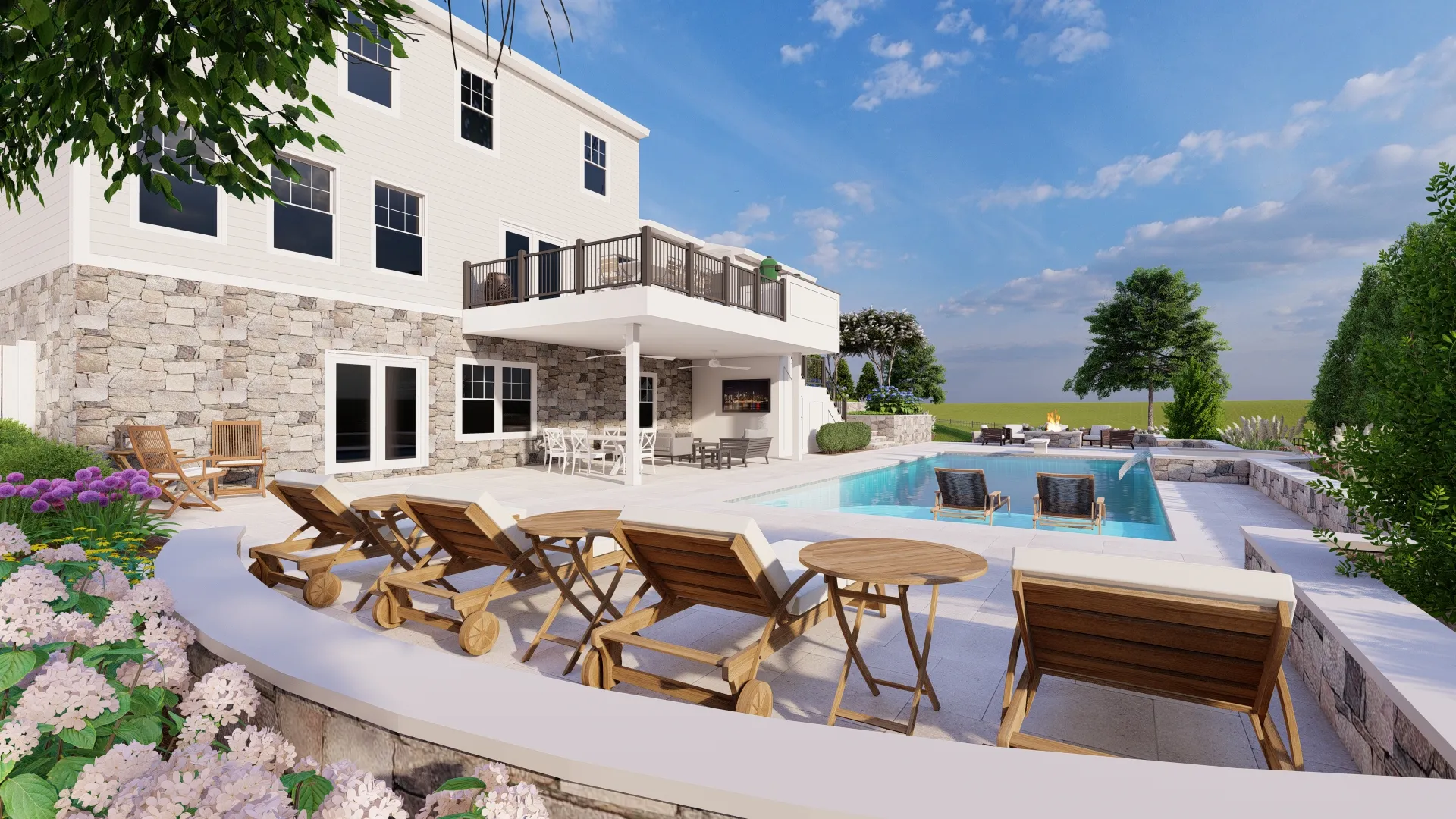
When homeowners start planning an outdoor living project, most focus on what they want to build.
Should they add a patio? A pool? An outdoor kitchen? A fire feature?
But according to Lillian Turner, Landscape Designer at Outdoor Spaces in Northern Virginia, one of the most important decisions often comes before any of that:
Where should the space actually go?
Should your outdoor living area be located directly off the house for convenience, or should it become a destination farther into the yard?
The answer depends on much more than personal preference. Your property layout, lifestyle, family habits, and long-term goals all play a role.
What Is a Destination Backyard?
A house-adjacent outdoor living space is exactly what it sounds like. Your patio, deck, porch, or outdoor kitchen is located directly off the home, creating a seamless transition between indoor and outdoor living.
A destination backyard takes a different approach. Rather than extending the house outward, it creates a separate outdoor experience somewhere else on the property.
This might be:
- A pool complex farther into the yard
- A secluded fire pit near the woods
- A pavilion overlooking a view
- A pool house and entertainment area away from the home
“A destination space can feel more like an escape,” says Turner. “You don’t have to sit there and stare at the back of your house. You can plant more around it and create a feeling that you’re somewhere completely different.”
Why Most Homeowners Benefit from Staying Close to the House
While destination spaces can be beautiful, Turner generally recommends keeping primary outdoor living areas close to the home whenever possible.
“Close is convenient,” she explains. “If you have the space here and the space there, I generally think the better use of your money is close by because you’ll be more likely to use it.”
The reality is simple: people naturally gravitate toward convenience.
When your outdoor living space is located directly outside your back door:
- Food and drinks are easier to access
- Guests naturally move between inside and outside
- Parents can keep an eye on children
- Furniture and accessories are easier to maintain
- You are more likely to use the space for everyday activities
Even a short walk across the yard can become a barrier over time.
When a Destination Backyard Makes Sense
That doesn’t mean destination spaces are the wrong choice. In fact, some properties practically call for them. One common example is larger lots where homeowners want to take advantage of a particular feature of the property.
Sometimes that means building around:
- Mountain views
- Mature trees
- Natural shade
- Existing topography
- Open fields or meadows
- Privacy away from neighboring homes
“Sometimes I’m trying to frame certain views,” Turner says. “If you put the space farther out and angle it a certain way, maybe you’re looking toward the mountains instead of toward your neighbor’s house.”
Destination spaces can also make sense when practical constraints limit what can be built near the house.
For example:
- Septic systems and drain fields
- Existing utility lines
- Mature trees homeowners want to preserve
- Steep grades
- Drainage challenges
In some cases, moving farther away from the house actually creates more design freedom.
The Features That Work Best Close to the House
Some outdoor living features naturally benefit from being near the home.
Dining Areas
Dining spaces are usually most successful when they’re close to the kitchen.
“You’re typically preparing food inside and bringing it outside,” says Turner. “Unless you’re planning a full outdoor kitchen where you’re cooking and preparing food outside, dining areas generally work best close to the house.”
Everyday Gathering Spaces
Patios, seating areas, and casual outdoor living rooms tend to see the most use when they’re easy to access.
If your goal is creating a space you’ll use multiple times per week, convenience matters.
Family Spaces
For families with young children, staying close to the house often makes supervision easier and encourages more frequent use.
The Features That Work Well as Destinations
Some outdoor features actually benefit from being separated from the main living area.
Rustic Fire Pit Areas
One of Turner’s favorite destination concepts is a more natural fire pit setting.
“Sometimes people want something that feels more rustic or more like camping,” she explains. “A gravel fire pit area near the woods can feel completely different from a formal patio.”
These spaces often feel more authentic when they’re tucked into a natural setting rather than attached directly to the house.
Pools and Pool Complexes
Larger pool projects can benefit from additional space and flexibility.
A destination pool area may allow room for:
- Expanded pool decks
- Pool houses
- Outdoor kitchens
- Dedicated entertainment spaces
- Additional privacy
The key is creating enough amenities that people can comfortably stay there rather than constantly walking back and forth to the house.
A Question of Lifestyle, Not Just Design
Outdoor spaces should be designed around how people actually live, not how they imagine they’ll live. Some homeowners love spending time outdoors. Others like the idea of spending time outdoors. Those are not always the same thing.
“I think knowing yourself is important,” says Turner. “Some people love nature. They like watching birds, sitting under trees, and spending time outside. Other people don’t want to walk barefoot across the grass.”
That distinction can dramatically influence the right design solution.
A homeowner who already spends weekends gardening, birdwatching, or relaxing outdoors may love a destination space tucked into a wooded area. A homeowner who rarely goes outside may be better served by a convenient patio just outside the back door.
Questions to Ask Before Choosing a Destination Backyard
Before deciding where your outdoor living space should go, consider:
- How much time do you currently spend outside?
- How often do you realistically expect to use the space?
- Are you looking for convenience or escape?
- Will children regularly use the space?
- Do you want outdoor dining?
- Are there views, trees, or natural features worth highlighting?
- Are there site limitations near the house?
- Will you need amenities like bathrooms, refrigeration, or storage?
- Are you designing for your lifestyle or for resale value?
The Bottom Line
A destination backyard can create a memorable outdoor experience, but it isn’t always the best investment.
For most homeowners, outdoor living spaces located close to the house are easier to access, easier to maintain, and more likely to be used regularly.
“If you’re trying to choose between the two,” says Turner, “I think you’d need a really strong reason for putting it far away.”
The best outdoor living space isn’t necessarily the most dramatic one. It’s the one your family will actually use.
That’s why every Outdoor Spaces design process starts with understanding how you live, how you entertain, and how you want to experience your property. Once those questions are answered, the right location often becomes clear.